Keeping Costing and Prep Consistent Across Locations
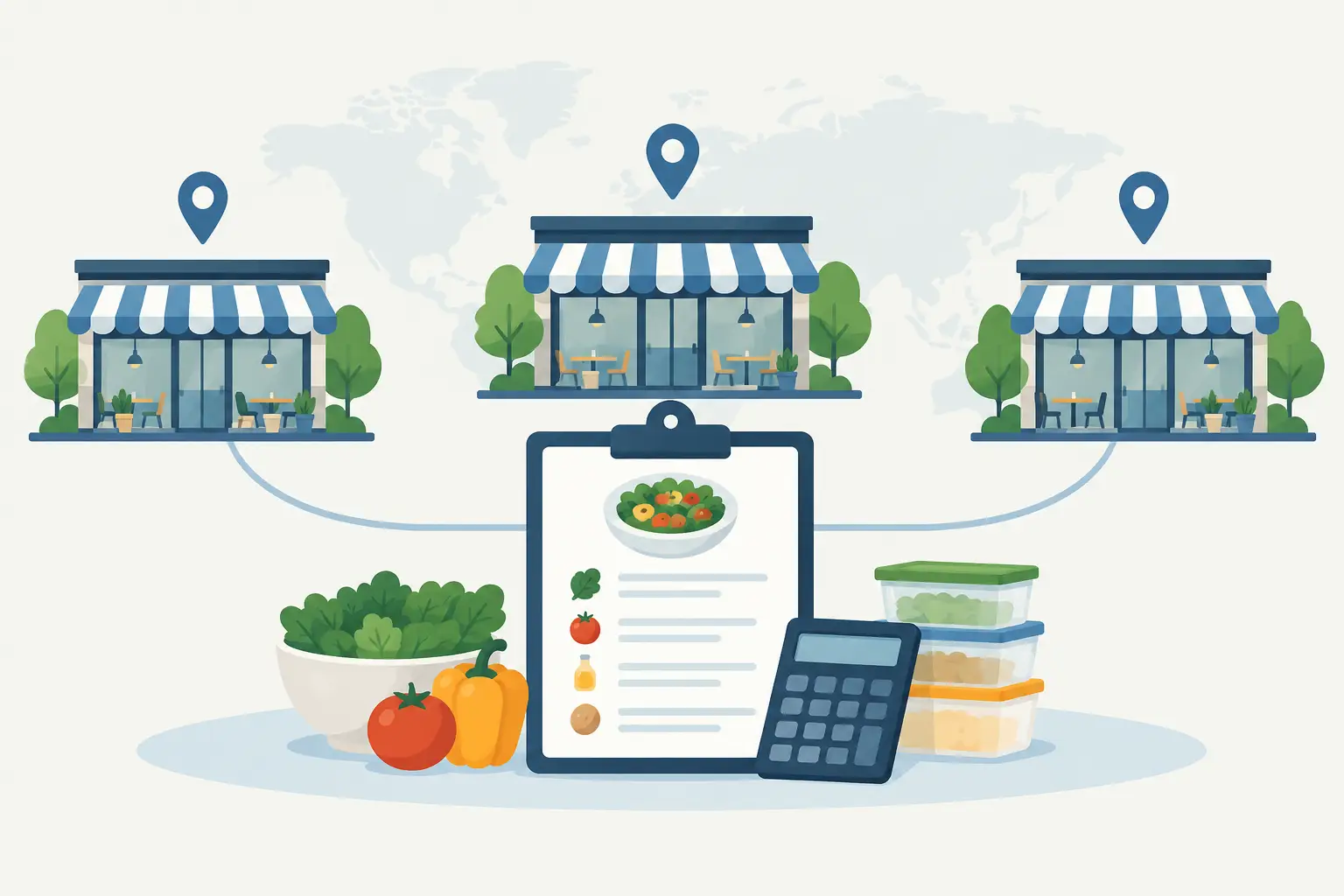
A pasta dish that costs $4.82 in one location and $5.41 in another is not necessarily a pricing problem. It is usually a control problem. Keeping costing and prep consistent across locations means every kitchen is working from the same current recipe, yield, supplier price, portion size, and sales expectation - not its own version of the truth.
That sounds basic because it should be. Yet multi-location operators routinely inherit a patchwork of recipe cards, spreadsheets, printed prep sheets, local substitutions, and supplier invoices that never make it back to the person setting menu prices. The result is familiar: one kitchen overpreps, another runs out, food cost drifts, and nobody can say exactly where the margin went.
Consistency starts before prep begins
The first mistake is treating recipe costing and prep planning as separate jobs. They are connected by the same operational data. If a recipe changes, the cost changes. If covers change, prep changes. If a supplier price changes, the margin changes. When those updates live in different files, emails, and binders, consistency becomes a manual chase.
A group needs one approved recipe record for each dish and component. That record should define ingredients, units, pack sizes, trim or cooking yields, method, batch yield, serving size, allergens, and plating quantity. It also needs a clear owner. A recipe with five unofficial editors is not standardized, even if it looks polished.
This does not mean every location must cook without judgment. A coastal site may use a different fish supplier, and a hotel breakfast operation may need a larger batch than a neighborhood café. The standard is not identical purchasing at all costs. The standard is that every approved variation is visible, costed, and connected to the same menu decision.
Cost to the real serving, not the bulk batch
Batch recipes create false confidence when they are costed only at the pot, pan, or cambro level. A sauce may appear to cost $38 per batch, but the number that matters is the cost per usable ounce after reduction, hold loss, and actual portioning. The same applies to proteins after trim, fryer oil after filtering, and garnish that cooks keep adding by hand.
Costing to the cent requires realistic yields and serving units. If one location portions a six-ounce chicken breast and another serves seven ounces because the scale is missing or the spec is vague, the recipe is not consistent. The menu may carry the same name, but the operation is selling two different dishes.
Set a defined portion, provide the tool to hit it, and make the standard easy to see on the line. That might mean a scoop number, a ladle size, a marked container, a portion scale, or a photo reference. Precision has to survive a busy Friday service, not just a Monday manager meeting.
Keeping costing and prep consistent across locations
The practical goal is simple: enter information once, then let it drive the work that follows. When recipe data sits at the center, a price update can recalculate plate cost and food-cost percentage. A revised serving size can flow into recipe books, prep requirements, and menu profitability. A booking increase can change expected production before the team starts chopping.
That is far stronger than asking each chef to remember which spreadsheet needs updating. Memory is not a system, and neither is a shared folder full of files with names like “final menu cost v7.”
A working location-level process has four controls:
- A shared master recipe, with locally approved variants clearly labeled.
- Ingredient costs tied to current supplier packs and units, not old case prices.
- Sales and booking forecasts that translate into expected portions by location.
- Prep lists generated from recipe quantities, on-hand stock, and realistic pars.
Each control addresses a different failure point. Master recipes stop variation from becoming invisible. Current supplier pricing exposes margin movement before the invoice does. Forecasts prevent prep decisions based on last week’s gut feeling. Inventory-aware prep stops kitchens from producing another batch when three unopened batches are already in the walk-in.
Build prep from demand, not habit
Many kitchens prep to a fixed number because that is what they made last Thursday. That works until a private event books, the weather changes, a menu item takes off online, or a nearby office closes for the day. Par levels are not guesswork, but they are not permanent either.
Start with forecasted covers, bookings, historical item mix, and known events. Convert that demand into projected portions of each menu item, then into component quantities. Finally, subtract usable on-hand stock and account for shelf life. The output should be a prep list that tells the team what to make, how much to make, and what batch or recipe it belongs to.
The key word is usable. A container of roasted vegetables that will not hold through tomorrow should not be counted as fully available stock. Nor should a partial batch with no label, date, or confidence behind it. Prep planning gets more accurate when teams record waste and excess stock honestly instead of treating those numbers as a blame exercise.
There is a trade-off here. A tightly forecast kitchen can reduce waste, but it can also leave too little buffer for a surprise rush. The answer is not to pad every prep list. Set buffer levels for high-risk, fast-moving items and review them by location. A downtown lunch site needs different cover protection than a destination dinner restaurant.
Give local teams room to operate without losing control
Central standards fail when they ignore the realities of individual kitchens. Delivery schedules differ. Storage capacity differs. One location may have a combi oven, another may not. A catering kitchen may prep two days ahead while a small café works in shorter cycles.
The answer is controlled flexibility. Keep the core recipe, yield, portion, and menu price logic consistent, while allowing approved location-specific supplier items, production batch sizes, and pars. If a substitute ingredient is necessary, it should be entered as a substitution with its own cost and allergen impact, not scribbled onto a printed recipe card.
This protects both the brand and the operator. Head office can see whether a local supplier change has pushed food cost beyond the target. The chef can still buy what is available and keep service moving. Neither side has to pretend that every kitchen has the same constraints.
Plate Margin is built around this workflow: one recipe entry connects live costing, menu analysis, forecast-led prep, and supplier-aware ordering across venues. Change the recipe, price, menu, sales report, or booking forecast, and the connected operational tools update with it. That is the difference between having data and using data during an actual prep shift.
Audit the handoffs, not just the numbers
A weekly food-cost report can tell you that a location is off target. It rarely tells you why. To find the cause, review the handoffs between purchasing, receiving, prep, service, and waste.
Ask practical questions. Did the receiving team enter the correct pack cost? Did the kitchen use the approved recipe version? Was a portion tool available and used? Did the prep list account for a large booking? Was waste recorded when a batch broke, expired, or was overproduced? These are operational questions, and they produce operational fixes.
Keep reviews short and specific. A chef does not need a lecture about variance. They need to know that diced avocado is being prepped 20% over forecast at one site, or that a vendor’s new pack size changed the cost of a signature salad. Then they can act: adjust the prep quantity, update the vendor item, retrain portioning, or reconsider the menu price.
Consistency is not achieved by sending more instructions to more kitchens. It comes from making the right information current, shared, and useful at the moment work happens. When every location can see the same recipe truth and turn it into the right prep for its own service, margin control stops being a monthly postmortem and becomes part of the shift.