Multi-Site Kitchen Scaling Without Losing Control
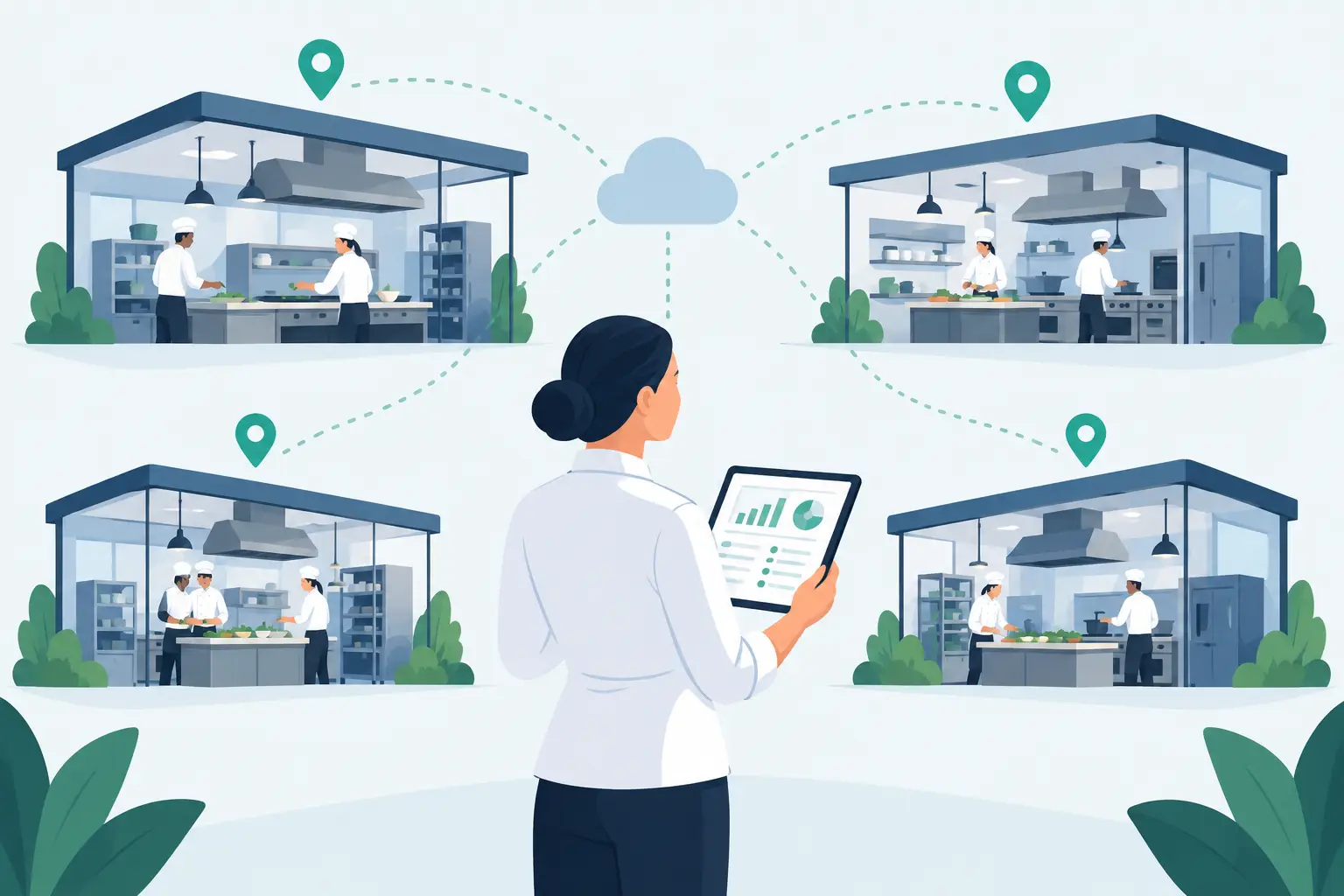
The second kitchen is where good intentions start getting expensive. A recipe that lives in a chef’s notebook at one site gets retyped elsewhere. A supplier price changes, but only one manager updates the spreadsheet. One location preps for last week’s sales pattern while another runs short before service. Multi-site kitchen scaling is not primarily about opening more doors. It is about making sure every door runs from the same operational facts.
Growth exposes the weak points a single kitchen can work around. A strong head chef can catch an outdated cost, remember the correct garnish, and make a last-minute ordering call. Across five locations, memory becomes a liability. The system has to do the remembering.
Standardize the work, not every local decision
The goal is not to turn every kitchen into a copy-and-paste operation. Different neighborhoods, service patterns, storage footprints, and supplier arrangements create real differences. A downtown lunch site may sell twice the covers of a suburban dinner-led location. A hotel kitchen may have banquet prep that a café does not. Treating those kitchens as identical creates bad pars and unnecessary waste.
What should be shared is the operational backbone: approved recipes, ingredient specifications, yields, allergens, portions, units of measure, and current costs. That gives every site the same starting point for execution and every operator the same basis for judging performance.
Local teams can then work within clear guardrails. They may have different order days, delivery windows, menu availability, prep schedules, and demand forecasts. The recipe for a chicken sandwich should still call for the same portion, method, and components unless there is a deliberate, documented reason to change it.
That distinction matters. Standardization protects margin and consistency. Local flexibility protects service.
Start with recipes that can survive handoff
A recipe is not scalable because it has a name and a food cost attached. It has to be usable by someone who did not write it, in a kitchen that may be busy, short-staffed, and receiving a different pack size than the original site.
Every core recipe needs precise quantities, prep yields, portion yields, methods, holding guidance, allergen information, and the actual ingredients used to produce it. “One case tomatoes” is not a recipe quantity. Neither is “season to taste” when the seasoning affects consistency, allergens, or cost.
The costing has to follow the same discipline. If a sauce recipe uses 500 grams but the invoice price is per pound, the conversion should happen in the system, not in each manager’s head. If trim loss is 18 percent, cost the usable yield, not the weight that arrived at the back door. Otherwise the food-cost percentage looks healthy right up until the invoice does not match the story.
A central recipe library also stops quiet recipe drift. Without it, small substitutions become permanent: a different cheese, a heavier scoop, a changed garnish, or a new vendor item that was never costed. Each decision can seem harmless. Across several sites and thousands of covers, it becomes the margin leak nobody can explain.
Make cost changes visible before they hit the menu
Opening more locations increases buying volume, but it also multiplies exposure to price movement. If avocado, beef, cooking oil, or dairy changes price, operators need to know which recipes and menu items are affected immediately. Waiting for month-end reporting is too late. The food was bought, prepped, sold, and probably priced incorrectly weeks ago.
This is where disconnected tools fail. A purchasing file may show the new price, while recipe costs live in another spreadsheet and menu prices in a separate document. The operator has information, but no line of sight.
For multi-site kitchen scaling to hold, an ingredient price update must recalculate every connected recipe, plate cost, and menu margin. That turns a supplier invoice into an operational prompt: absorb the increase, change the portion, source an alternative, rework the dish, or adjust the selling price. The right answer depends on the item and the guest proposition. The point is to make the decision deliberately, with costing to the cent.
Menu engineering becomes more useful at this stage. A dish with a strong contribution margin at one location may be a poor use of labor or prep capacity at another. Sales mix matters. So does whether a dish drives beverage sales, supports a catering package, or creates waste because its components do not cross over into other menu items. Margin is not just a percentage. It is the money left after the plate is paid for, and it needs to be read alongside volume and operational effort.
Multi-site kitchen scaling needs location-level demand
Central recipes do not mean central pars. Par levels are not guesswork, and they are not a fixed number copied from the flagship site.
Each kitchen needs prep and ordering quantities based on its own likely demand. Historical sales are useful, but they are only part of the picture. Reservations, bookings, events, day of week, seasonal traffic, menu changes, and known closures all affect what the team should prepare.
A location with a 150-cover private event should not be using the same prep list it used last Tuesday. Nor should a catering kitchen build its order from restaurant sales alone. When forecasts incorporate actual bookings and current sales patterns, prep lists can build themselves around expected demand rather than intuition.
That reduces two expensive habits: over-prepping because nobody wants to run out, and emergency buying because nobody saw the demand coming. Both feel like operational insurance. Both usually come out of margin.
There is a trade-off. Forecasts should guide a kitchen, not replace judgment. A new promotion, a sudden heat wave, a local event, or a service issue can make the expected number wrong. Good systems give chefs a calculated starting point and make overrides visible. They do not pretend the kitchen is predictable to the last portion.
Keep ordering tied to what the kitchen actually uses
Ordering gets messy quickly as locations add suppliers, pack sizes, delivery days, and approved alternatives. The common response is a master order guide with so many tabs and exceptions that no one trusts it. That is not control. It is a document waiting to go stale.
A useful ordering process starts with recipes and forecast demand. If the projected prep list requires 30 pounds of cooked chicken, the order should account for the raw yield needed to produce it, current stock on hand, existing orders, and the supplier’s available pack size. If there is excess stock, the team should see it before buying another case.
Supplier-aware lists matter because the same ingredient may arrive in different formats or at different prices by location. Standardize the ingredient specification where possible, but keep supplier and pack details practical at the site level. A purchasing manager needs to know what to buy. A chef needs confidence that what arrives will produce the recipe as costed.
This is also where accountability becomes real. Record waste, excess stock, and missed or substituted deliveries. Otherwise, the group sees a food-cost problem but cannot tell whether the cause was over-portioning, inaccurate receiving, poor forecasting, spoilage, or an unapproved purchase.
Build one operating rhythm across the group
More locations create more data. The mistake is assuming more dashboards solve the problem. Kitchens need a repeatable rhythm: check cost movement, review forecast demand, generate prep, place orders, record variances, and investigate exceptions. The tools should support that sequence rather than create another admin task.
Group leaders need a clear view of which sites are drifting from recipe standards, carrying excess stock, wasting high-value products, or running menu items below target margin. Site chefs need a practical daily view that tells them what to prep, what to order, and what has changed. Those are different jobs, and they require different levels of detail from the same source of truth.
Plate Margin is built around that connection. Enter a recipe once, then let the same data feed live plate costs, menus, allergens, prep lists, forecasting, and supplier-aware ordering across every venue. When an ingredient cost or menu changes, the connected work updates with it. That is how the group avoids running five versions of the truth.
Scale control before you scale headcount
The best time to build these controls is before the third or fourth location makes the gaps painful. Once teams are improvising different costing methods, different recipe files, and different ordering habits, cleaning it up becomes a recovery project.
Start with the highest-volume and highest-risk items. Get their recipes, yields, supplier data, and portions right. Use those records to create trustworthy prep and ordering workflows. Then expand the standard across the menu and the group. Perfection is not the first requirement. A shared, current system that teams actually use is.
More kitchens should mean more buying power, more consistency, and more confidence in the numbers. If growth only creates more spreadsheets and more surprises, the operation is scaling its confusion. Build the controls while the group is still small enough to care about every case, every portion, and every dollar of margin.