How to Set Restaurant Par Levels Without Guesswork
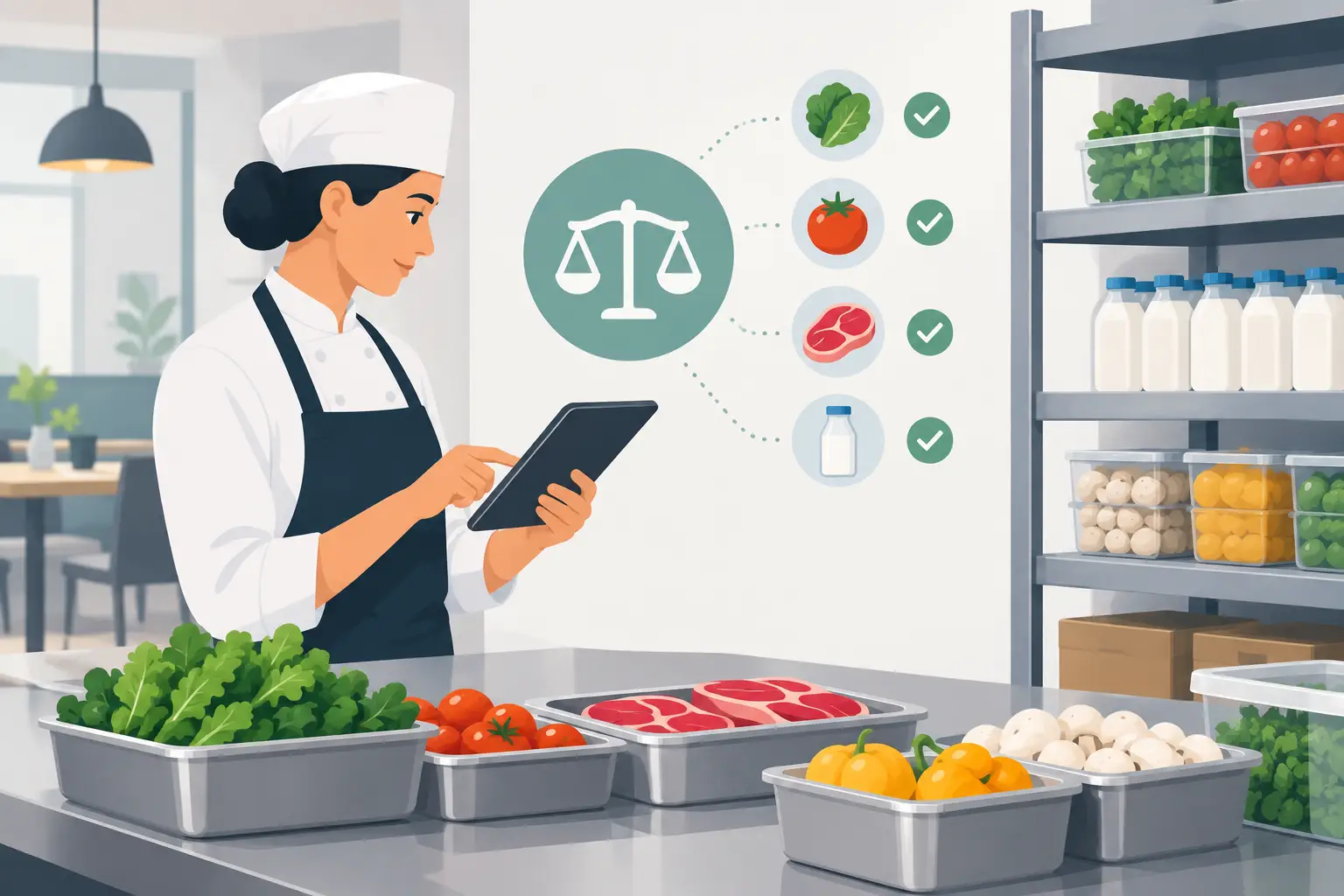
Saturday service is not the time to learn that your chicken par was based on a quiet Tuesday three weeks ago. Too little stock creates 86s and rushed substitutions. Too much stock ties up cash, crowds the walk-in, and becomes tomorrow’s waste. Knowing how to set restaurant par levels gives the kitchen a usable line between those two failures.
A par level is not a hopeful number written beside an ingredient. It is the amount of usable product you need on hand to cover expected demand until the next delivery can replenish it, with a realistic buffer for normal variation. The number should change when sales, bookings, supplier lead times, recipes, yield, or service patterns change. Par levels are not guesswork.
Start with demand, not the shelf
The cleanest way to build a par is to start with what the kitchen actually sells. Pull a representative period of sales, usually the last four to eight comparable weeks. Separate lunch from dinner if their mix is materially different. Separate weekdays from weekends if Friday behaves nothing like Monday. For catering and events, use confirmed covers and menu selections rather than an average that hides a 150-person function.
Then translate menu sales into ingredient demand through standard recipes. If you sell 120 portions of a dish and each portion uses 6 ounces of trimmed chicken, you need 45 pounds of usable chicken. If trimming and cooking loss mean your yield is 80%, you need to buy 56.25 pounds, not 45.
This is where many pars go wrong. Operators set a par for cases because that is what arrives at the back door, while recipes are costed in pounds, ounces, or portions. Those units are not interchangeable. Build the calculation from the recipe quantity upward, then convert to the supplier pack size at the end.
Use the right sales window
Averages can be useful, but only when they describe the next service. A neighborhood café may use a rolling four-week average for milk and pastries. A restaurant in a tourist market may need last year’s seasonal pattern, current reservations, and local event bookings. A steakhouse that sees most of its volume Friday and Saturday should not let five quieter days dilute the weekend par.
If sales are growing, a trailing average will lag behind reality. If a menu item was removed, its historical sales should not keep driving purchases. Use history as evidence, not as an instruction sheet.
Calculate par around delivery lead time
The core calculation is straightforward:
Par level = expected usage during lead time + safety stock
Lead time means the full period between placing an order and being able to use the product. If you order produce on Monday at 2 p.m. and receive it Wednesday morning, plan for the demand between those points. If your supplier has a cutoff, include that too. Missing a cutoff can turn a one-day lead time into three days.
For example, a kitchen uses 18 pounds of romaine per day and receives produce every two days. Expected usage is 36 pounds. If normal variation calls for a 20% buffer, safety stock is about 7 pounds. The working par is 43 pounds.
That does not mean ordering 43 pounds every time. It means 43 pounds is the target amount to have available after the delivery is put away. Your order is the gap between the target and what you already have.
Order quantity = par level - usable inventory on hand + committed demand
Committed demand includes booked events, planned specials, or prep already allocated to another service. Count usable inventory, not every item physically in the building. Wilted herbs, product held beyond its quality window, and cases reserved for a function are not available stock.
Safety stock should have a reason
Safety stock protects service from ordinary variation: a busier shift, a short delivery, a little more trim loss, or an item selling above forecast. It is not a place to hide poor counting or vague purchasing.
A stable dry good with reliable deliveries may need only a small buffer. Fresh fish with variable availability, a specialty import with an inconsistent supplier, or a high-selling ingredient that cannot be substituted may need more. The trade-off is clear: a larger buffer lowers the chance of a stockout but raises the risk of waste and cash sitting in storage.
Set the buffer in units the team can understand. For burger buns, that may be one extra tray. For house-made dressing, it may be one service day. For expensive proteins, it may be a tightly controlled percentage of forecast demand rather than a full extra case.
Account for yield, shelf life, and storage
A par that ignores yield is an expensive fiction. Whole produce, bone-in proteins, whole fish, and products with cooking loss must be purchased above the usable recipe requirement. Record the yield from your own prep, not a textbook assumption. If your prep team gets 72% usable yield from a case of artichokes, that is the number purchasing needs.
Shelf life matters just as much. A three-day par may be logical for canned tomatoes and reckless for cut berries. The delivery schedule does not automatically decide the par. Your quality window does.
For highly perishable items, consider setting a daily par or a prep par rather than holding extra raw product. If the kitchen can make dressing in 15 minutes, holding two extra days of finished dressing may create more waste than protection. If a sauce takes four hours to produce and supports several menu items, a larger controlled par can be justified.
Storage is the final reality check. Do not set a par that cannot be rotated, labeled, and counted properly in the space you have. A crowded walk-in is not insurance. It is a place where older product disappears behind newer cases.
Build separate pars for purchasing and prep
One number rarely controls the whole kitchen. Purchasing pars answer, “How much raw material do we need to order?” Prep pars answer, “How much ready-to-serve product do we need for the next service?” They connect, but they should not be confused.
Take salsa as an example. The purchasing par covers tomatoes, onions, cilantro, citrus, and packaging based on forecasted production. The prep par covers the number of quarts of finished salsa needed for tonight’s expected covers, plus a sensible buffer. If the kitchen only measures raw inventory, it can have plenty of tomatoes while still running out of finished salsa at 7:30.
Recipes are the bridge. When every batch has a standard yield and every menu item has a standard portion, sales forecasts can turn into prep needs and then into supplier orders. Plate Margin is built around that connected workflow: a recipe change updates the numbers feeding costing, prep, and ordering instead of leaving three separate spreadsheets to drift apart.
Count consistently before you order
A par system is only as good as the inventory count beneath it. Count at the same point in the day, preferably before ordering and after the prior service has been recorded. Use consistent units. Do not count some items by case, some by “about half,” and others by pounds unless the system converts those units accurately.
Make the count practical for the people doing it. High-value proteins, fast-moving produce, dairy, beverages, and core dry goods deserve regular attention. Low-cost, slow-moving staples can be counted less often if that matches the operation. The goal is not to create paperwork. The goal is to know what is actually available before the invoice does.
When a count is wrong, investigate the cause. It may be unrecorded waste, over-portioning, a receiving error, staff meal usage, theft, or a recipe that no longer matches the plate. Repeated variance is useful information. Raising the par to cover it only makes the problem less visible.
Review pars when the operation changes
A par list should be reviewed on a rhythm, but not every item needs the same attention. Fast-moving perishables may need a weekly adjustment. Stable pantry products might only need a monthly review. Review immediately when any of these inputs moves: menu mix, portion size, supplier pack size, delivery days, bookings, seasonality, or a major price change that affects purchasing decisions.
Watch for the warning signs. Frequent 86s usually mean the forecast, lead time, or buffer is too low. Recurring waste means the par, shelf-life assumption, or prep batch is too high. Constant emergency orders often point to a missed ordering cutoff, unreliable counts, or a par built around averages that do not reflect actual service patterns.
The best par is not the largest number that prevents an 86. It is the smallest defensible amount that protects service, respects shelf life, and leaves the kitchen in control. Set it from recipes, sales, bookings, and real lead times, then keep testing it against what the team uses. That is how purchasing gets tighter without making service fragile.